

close

Every successful organization wants the same outcome: strong safety performance, operational excellence, and teams that can anticipate challenges before they become problems.
But many organizations still spend too much of their time reacting.
A mishap occurs. Non-productive time increases. A near-miss exposes a weakness. Complacency begins to creep in. Leaders and teams respond, correct the immediate issue, and move on.
Then the cycle repeats.
At CAVU, we believe the difference between organizations that continually react to problems and those that consistently stay ahead of them comes down to one fundamental shift: moving from reactive to proactive performance.
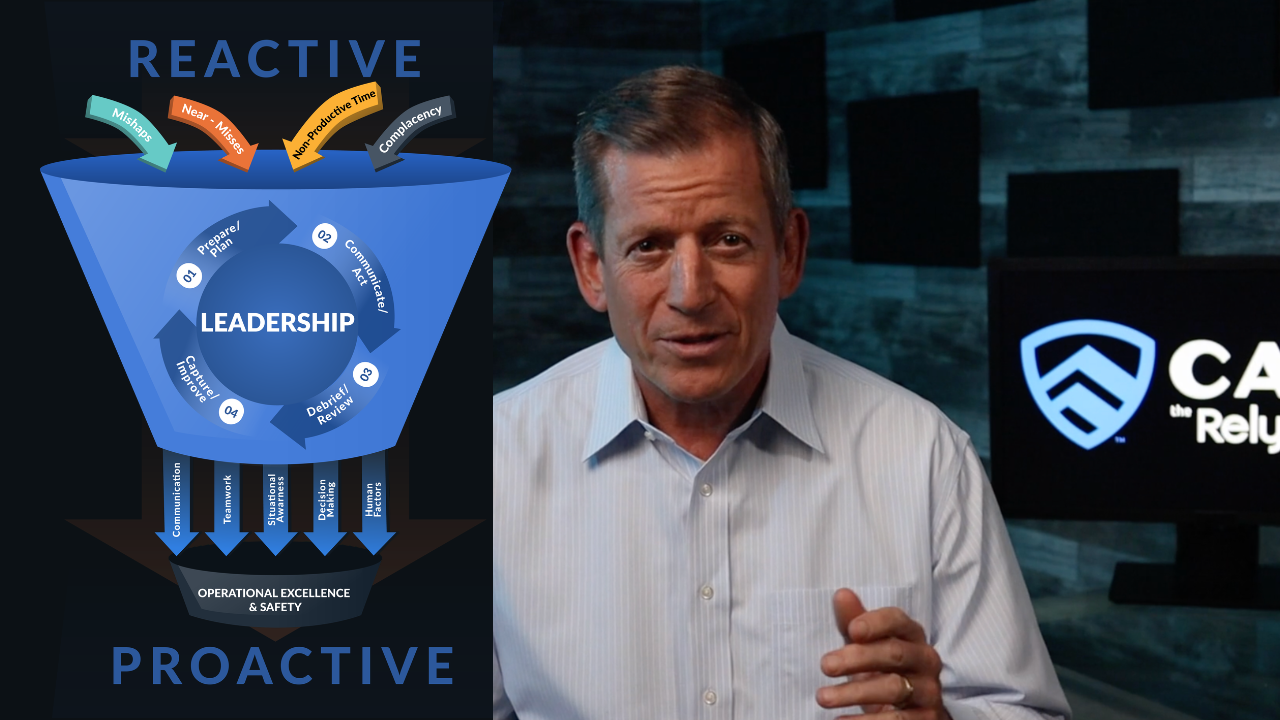
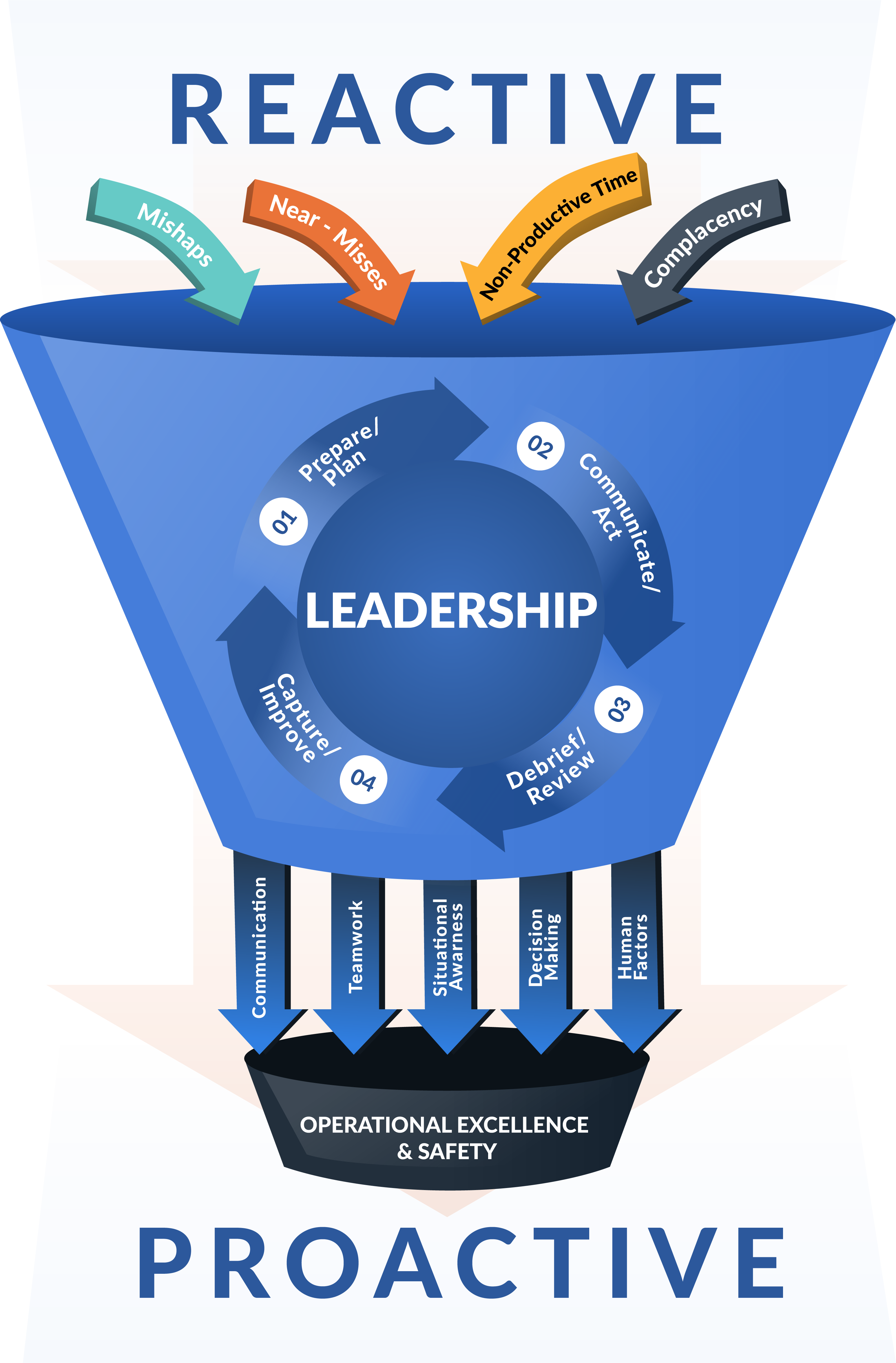
Our Reactive to Proactive Funnel illustrates how that shift happens.
The top of the funnel represents the issues organizations are trying to eliminate or reduce:
These are often treated as separate performance or safety problems. In reality, they can be symptoms of something deeper.
When teams lack a consistent process for planning, communicating, learning, and improving, they are more likely to find themselves responding to problems after they occur.
That reaction can be costly. It can affect productivity, schedule, morale, quality, and, most importantly, safety.
The goal is not simply to become better at responding. The goal is to build an organization capable of anticipating threats, strengthening barriers, and preventing problems from reaching the operation in the first place.
At the center of CAVU's funnel is leadership.
Moving an organization from reactive to proactive does not happen through procedures alone. It requires leaders who establish clear expectations, reinforce standards, encourage open communication, and create an environment where teams continuously learn from the work.
Strong leadership drives the behaviors and processes that allow an organization to improve deliberately rather than relying on luck, individual talent, or lessons learned only after something goes wrong.
Leadership is also what keeps the Continuous Improvement cycle moving.
CAVU's approach is built around a four-step Continuous Improvement cycle:
Prepare and Plan → Communicate and Act → Debrief and Review → Capture and Improve
It is a simple, repeatable process designed to become part of the way teams work every day.
Teams identify the objective, understand the standard, anticipate threats, and establish a clear plan before execution begins.
The team aligns around the plan and executes with deliberate, unambiguous communication.
After execution, the team evaluates what happened against the original plan and intended standard. What worked? What changed? Where were the gaps?
Successful behaviors are captured so they can be repeated. Challenges are identified so corrective actions can be built into the next cycle.
Then the process begins again.
This is what a true learning organization looks like in practice.
Processes alone do not create proactive teams. Human behavior determines how effectively those processes are executed.
That is why Team Resource Management, or TRM, is integrated throughout the funnel.
CAVU focuses on six critical TRM skills:
Leadership, Communication, Teamwork, Situational Awareness, Decision Making, and Human Factors.
These competencies reinforce one another.
When leadership establishes the right environment, communication becomes more deliberate. Better communication strengthens situational awareness. Greater situational awareness improves decision making. Human factors are recognized before they contribute to error. Teamwork creates greater ownership, accountability, and alignment.
Instead of waiting for something to go wrong, teams become better equipped to recognize changing conditions and respond before those conditions become consequences.
As leadership, Continuous Improvement, and Team Resource Management become embedded in the way an organization operates, the focus changes.
Teams spend less time chasing problems and more time preventing them.
The result is what every organization is ultimately working toward:
Safety and Operational Excellence.
These outcomes are not separate initiatives. They are the product of the same leadership behaviors, disciplined processes, and human performance skills.
A safer organization is often a better-performing organization because both require teams to plan effectively, communicate clearly, identify threats, make good decisions, learn from experience, and continuously improve.
Most organizations will recognize some part of themselves at the top of the funnel. That is not unusual.
The more important question is whether there is a deliberate process for moving downward.
Becoming proactive does not mean eliminating every unexpected event. It means creating the leadership capability, behaviors, and systems that allow teams to anticipate more, learn faster, strengthen defenses, and continuously improve.
That is the shift CAVU helps organizations make.
Ready to move from reactive to proactive? Let's connect.


© 2024 CAVU. All rights reserved. Site Design by Former Colleagues
