

close


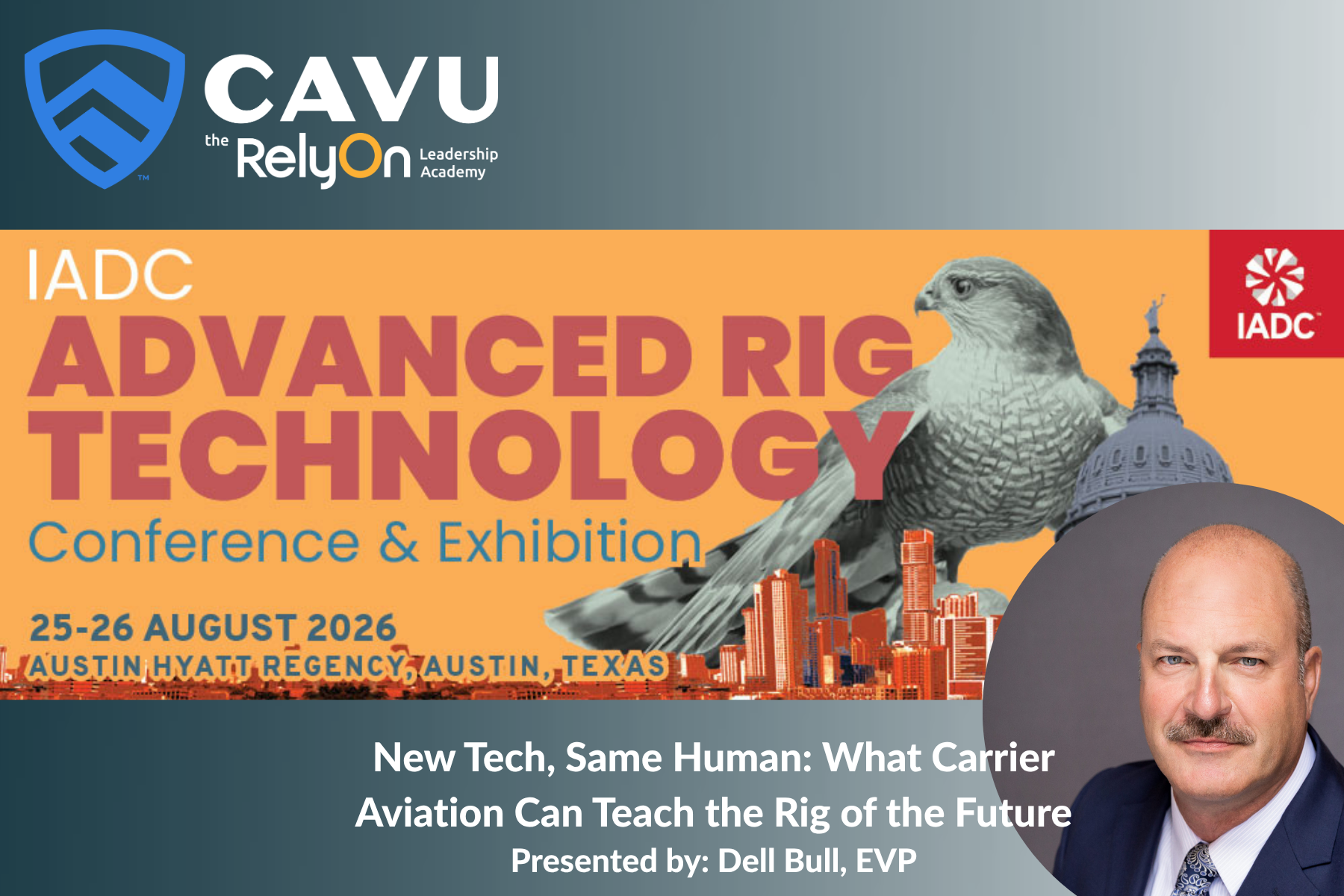
As drilling operations become more automated, connected, and technologically advanced, one challenge remains constant: the human being operating within the system.
That was the focus of Rear Admiral (Ret.) Dell Bull’s presentation at the IADC Advanced Rig Technology Conference, “New Tech, Same Human: Lessons from Carrier Aviation for the Rig of the Future.”
Drawing on decades of experience in U.S. Naval Aviation, Dell explored a reality that applies just as strongly to today’s drilling environment: technology can change much faster than people, teams, and operating practices do.
That gap matters.
New technology can dramatically improve capability, efficiency, and safety. But during the transition to new systems, it can also introduce new forms of operational risk if roles, communication, training, and decision-making do not evolve alongside it.
Dell’s perspective comes from operating and leading in one of the most technologically advanced and unforgiving environments in the world.
Throughout his naval career, he commanded strike fighter squadrons and an air wing aboard a nuclear-powered aircraft carrier. He later served as Chief of Naval Air Training, with responsibility for standardizing training and safety across thousands of aviators and hundreds of aircraft.
Naval aviation has undergone continuous technological change. Aircraft, sensors, automation, communications, and decision-support systems have evolved enormously. Yet the people using those systems are still subject to the same human limitations they have always had.
People can become overloaded. They make assumptions. They lose situational awareness. They misunderstand responsibilities. They place too much trust in technology.
And those vulnerabilities can become particularly visible when a new system changes the way work has traditionally been done.
Dell focused on three recurring challenges he has seen when new technology enters an operational environment.
Automation can change the flow of work without organizations fully recognizing that it has also changed responsibility.
Tasks that once clearly belonged to one person may now be shared between people and systems. Decisions may move between the frontline, remote personnel, automated tools, and supervisors.
If teams have not explicitly answered the question, “Who owns this decision now?”, ambiguity can develop at exactly the wrong moment.
In high-consequence operations, responsibility cannot simply be assumed.
Technology can improve the availability of information while unintentionally weakening communication.
When teams assume that everything important has already been captured in a system, they can begin to rely on the technology to perform functions that once depended on deliberate human interaction.
But data availability is not the same thing as shared understanding.
Effective handovers still require people to communicate what has changed, what matters, what remains uncertain, and what the next team needs to pay attention to.
Modern systems are often extraordinarily reliable.
That reliability can create its own risk.
The more consistently a system performs as expected, the easier it becomes for people to assume that it will continue doing so. Teams can become highly proficient at operating during normal conditions without being equally prepared for the unusual situation when the technology behaves differently than expected.
That is why training cannot focus exclusively on the normal day.
Teams also have to practice the edge cases.
The lesson from carrier aviation is not to slow technological progress. It is to make sure the operating system around the technology keeps pace.
Dell outlined several leadership practices that help organizations introduce new capability without increasing operational fragility.
Clarify decision ownership early. Before implementation, teams should understand exactly who is responsible for decisions at each stage of the operation, including what happens when automation reaches its limits.
Standardize the communications that matter most. Not every conversation needs to be scripted, but critical handovers, status updates, and decision points should have enough structure that essential information is consistently transferred.
Train the abnormal, not only the normal. Teams should understand what successful operation looks like, but they also need exposure to system limitations, unexpected behavior, degraded conditions, and situations requiring human intervention.
Create a learning rhythm. New technology will reveal lessons once it encounters real operations. Organizations need a simple, repeatable way to capture those lessons, communicate them, and turn them into updated practice quickly.
These are fundamentally leadership responsibilities.
Technology provides capability. Leaders create the conditions that allow people to use that capability safely and effectively.
For drilling organizations introducing advanced systems, automation, remote operations, or new decision-support tools, Dell encouraged leaders to ask several practical questions before implementation:
These questions are simple by design.
They force teams to examine the human side of technological change before those weaknesses reveal themselves during operations.
The drilling industry will continue to become more sophisticated. Automation, remote support, advanced analytics, and increasingly intelligent systems will change how work is performed.
But the goal cannot simply be to introduce more technology.
The goal is to increase capability without increasing fragility.
The experience of naval aviation offers an important reminder for the rig of the future: even as the technology changes, the fundamentals of reliable human performance remain remarkably consistent.
Clear roles. Deliberate communication. Realistic training. Strong leadership. Continuous learning.
New technology. Same human.


© 2024 CAVU. All rights reserved. Site Design by Former Colleagues
